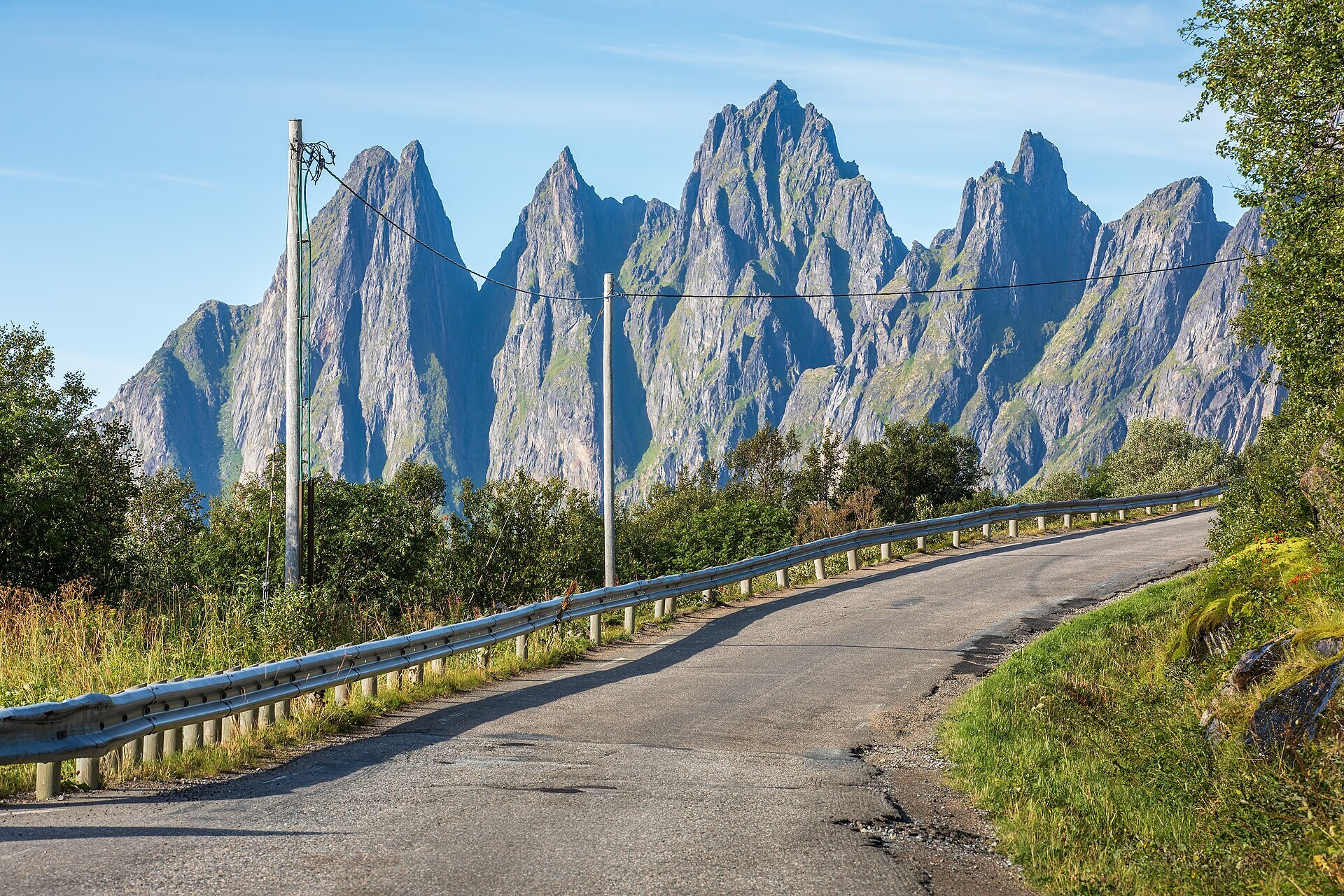
Senja and Lofoten sit at roughly the same latitude, share the same midnight sun and the same winter darkness, and both offer fjord-cut mountains dropping straight into the Norwegian Sea. That is where the similarity mostly ends. One island is on every Arctic Norway shortlist and has the infrastructure to match. The other is quieter, rawer, and asks a bit more patience from whoever drives it. Neither is the wrong choice, but they are not interchangeable, and the difference shows up in the details: road width, parking, bed stock, and how many other cars share your viewpoint at 9pm in July.
Landscape and scale
Lofoten is a long archipelago strung along the E10, roughly 170 km from the bridge near Fiskebøl down to Å. The peaks are sharper and more vertical in places, and the classic postcard shots (sweeping fjord villages, white sand against granite walls) are concentrated and well signposted. Senja, Norway's second largest island after Hinnøya, is more compact and less linear. Its best scenery clusters on the western and northern coast: Segla and Hesten above Fjordgård, the Bergsbotn viewing platform, the black-sand curve at Tungeneset. There are fewer must-see stops, but they are spread over quieter roads, and you are less likely to be queuing for a parking space to photograph them.
Getting there and driving
Lofoten is reached by E10 from Narvik (about 170 km, roughly 3 hours without stops), by direct flights into Svolvær or Leknes, or by the coastal ferry that calls at Stamsund and Svolvær on its route north and south. The E10 is a proper trunk road, two lanes, regularly plowed in winter because it carries real freight and bus traffic. Senja is usually approached from Tromsø: about 90 minutes to the Gisund bridge near Finnsnes, then another hour or more west on narrower county roads (Fv863, Fv862) to reach villages like Mefjordvær or Hamn. A seasonal car ferry also links Botnhamn to Brensholmen, shortening the Tromsø run in summer; check the day's schedule, since it does not run year round. Senja's roads are slower by design: more curves, fewer passing lanes, and sections that close in strong wind on the exposed west side.
Crowds and timing
Lofoten's fame has a cost. In July and August, camper vans queue at the narrow pull-offs near Reine and Å, and parking at the best-known viewpoints fills by mid-morning. Senja, even in high summer, rarely produces that kind of bottleneck. The same type of viewpoint, Bergsbotn or Tungeneset, might have a handful of cars rather than fifty. Shoulder months (late May, September) soften Lofoten's crowds considerably and are arguably the smarter time to visit either island: daylight is still long, temperatures are workable, and accommodation is easier to book without months of lead time.
If Lofoten is the plan, aim for viewpoints before 9am or after 7pm in summer. If Senja is the plan, normal daytime hours are usually fine, even in peak season.
Where to sleep and what it costs
Lofoten has the deeper bed stock: converted fishermen's cabins (rorbuer) in several price tiers, hotels in Svolvær and Leknes, and a dense network of campsites. Expect rough summer pricing from around 150 to 300 USD a night for a decent rorbu, less in shoulder season. Senja has far fewer beds overall, mostly guesthouses and cabins in the 100 to 180 USD range, with camping cabins cheaper still. The tighter supply means booking Senja accommodation early matters just as much as it does for Lofoten, despite the lower visitor numbers; there are simply fewer rooms to go around.
Aurora and winter driving
At nearly the same latitude, aurora odds are comparable between the two islands: both depend on KP index, clear sky, and the same dose of patience. Neither has a meaningful edge here, so pick based on roads and crowds, not on aurora claims. Winter driving differs more. Lofoten's E10 carries heavier traffic and gets cleared early and often. Senja's county roads, especially toward the exposed west coast, close more frequently in high wind or heavy snow, and some stretches get a lower maintenance priority. Either island demands winter tires, a full tank before heading into remote stretches, and a look at the day's road report (175.no) before setting out.
Which to choose
Choose Lofoten if you want the recognizable shots, easier flight access, and a wider range of beds and restaurants, and you do not mind sharing the road in summer. Choose Senja if you prefer fewer cars, slower roads, and are comfortable with a thinner safety net of services. Many travelers link the two through Tromsø, splitting a week roughly in half. There is no wrong pick here, only a mismatch between expectations and what each island actually offers on the ground.